What began as a simple wallet inside a browser is becoming one of the most widely used ways to interact with digital dollars on the internet — especially for people who were never crypto users before.
This growth has come from solving practical problems:
- helping global citizens get paid reliably
- helping families and businesses move money across borders
- letting travelers, expats, and nomads pay locally
- enabling people to save safely
- supporting work, community projects, and builders
All of it continues to run on Celo — whose onchain activity has expanded significantly this year — with USDT powering most of the everyday transactions inside MiniPay.
(Link: See the full 2025 roundup here)
 By the Numbers (Q4 2025)
This quarter, MiniPay quietly crossed new milestones:
- 12M+ total wallet activations
- 360M+ transactions processed
- Live in 66+ countries
And as MiniPay grows, the Celo ecosystem grows with it — more users, more activity, more real-world transaction flow.
Major Product Milestones

Earlier in Q3, we previewed Virtual USD and EUR accounts. In Q4, we fully launched them. Users can now receive ACH (USD) and SEPA (EUR) payments directly into MiniPay—with accounts in their own name, and with funds arriving instantly as stablecoins. Instantly spendable, or withdrawable to local currency in over 60 countries.
MiniPay also partnered with freelancer platforms like Ruul, enabling freelancers to receive payouts through MiniPay.
This matters because;
- People in regions cut off by “de-risking” in traditional finance can finally get paid like they have a US/EU account.
- Funds convert automatically into USDT or USDC — ready to use immediately.
- “Not available in your country” begins to fade.
We’re already seeing adoption across Nigeria, Latvia, Thailand, Colombia, Indonesia, and beyond.
Stablecoins are doing what DeFi set out to do: removing barriers and widening access.
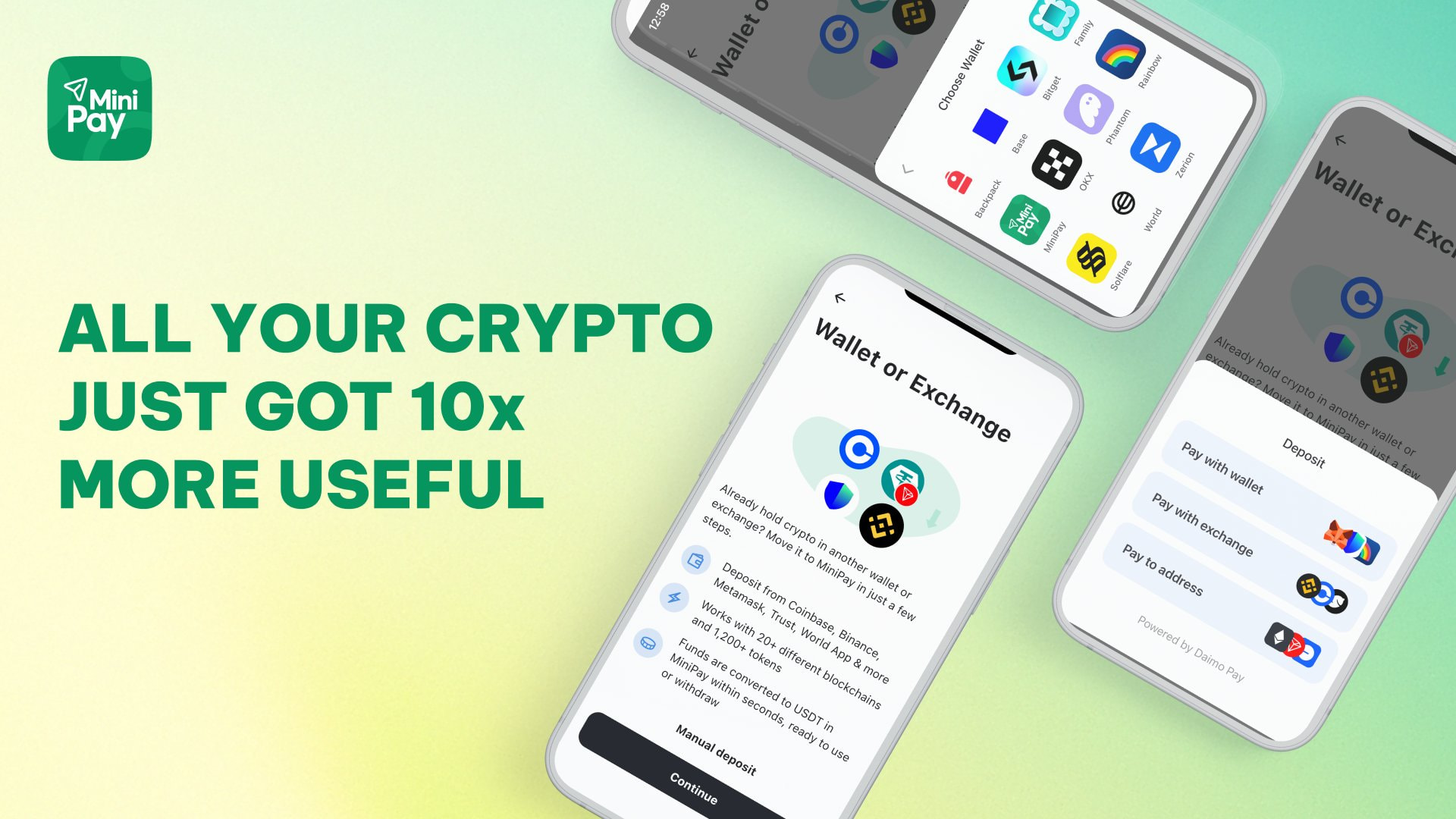
Cross-chain deposits integrated natively and powered by Daimo continue to expand.
Users can now bring assets from 10+ chains and convert thousands of tokens seamlessly into stablecoins inside MiniPay. This flow has already facilitated millions in deposits from other chains and wallets.
This matters because it is the interoperability that already works today.
- Users can bring in the value they already hold elsewhere— without needing to understand bridges. This can be crypto stuck in other wallets and exchanges
- Onboarding becomes dramatically simpler for newcomers
- Liquidity moves toward Celo naturally, because it’s easier
In Q4 we expanded “Pay with MiniPay,” making one stablecoin balance usable in more places.
We launched support for PIX (Brazil), Mercado Pago (Argentina), Local bank transfers in Nigeria, and SEPA (EU), with more countries and local methods coming soon.
The idea is simple: One digital dollar balance that can travel with you, and still work like local money wherever you are.
This brings stablecoins and DeFi closer to “real finance.”
Pre-Announcing: The MiniPay Card
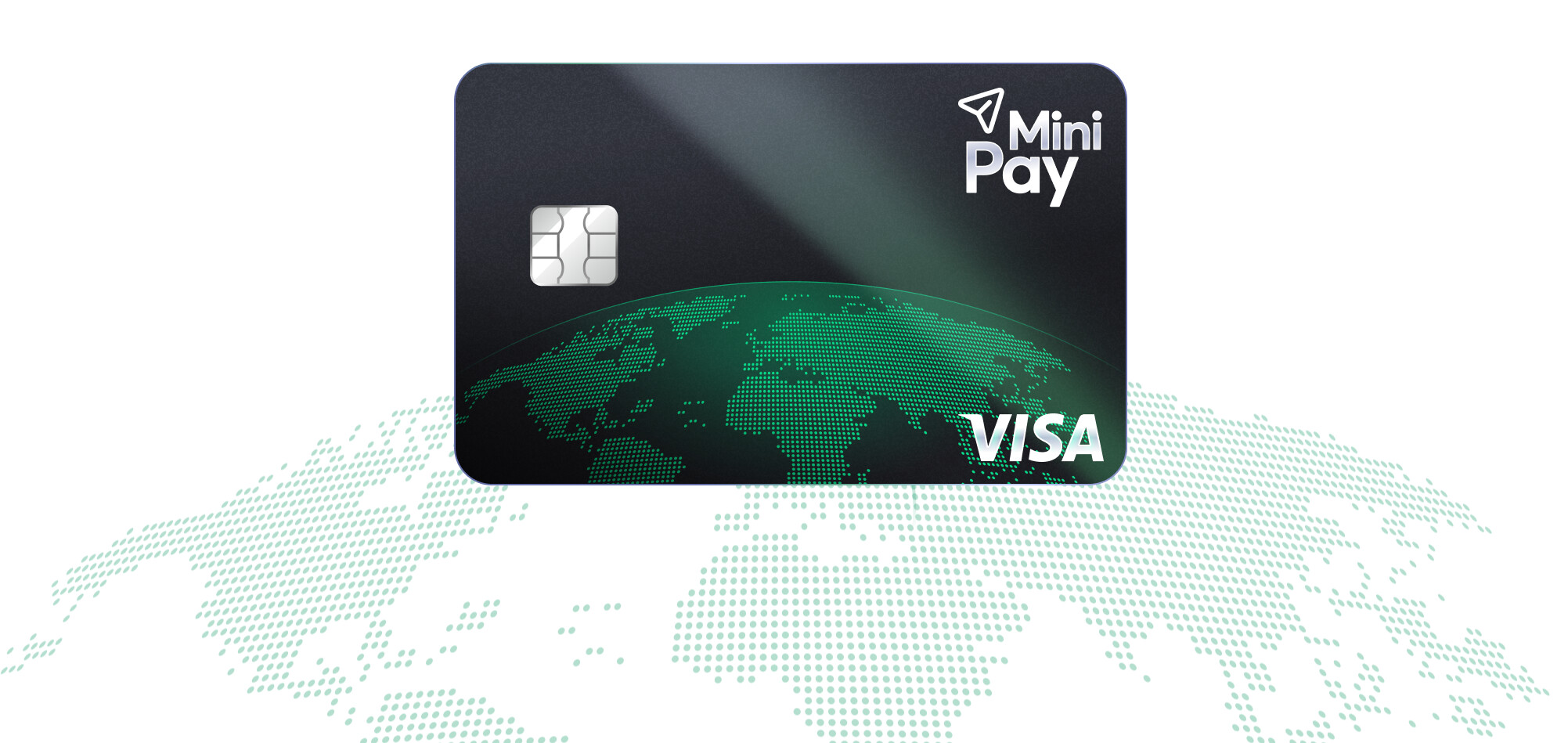
Another step toward everyday usability:
We’re pre-announcing the upcoming MiniPay Card, and giving the Celo community first dibs on early sign-ups.
Link to sign up here.
The goal of this feature is simple. Spend stablecoins anywhere a card works. We’re excited to see how this further expands the stablecoin use cases available in MiniPay and on Celo.
More details soon — but this unlocks a bridge between onchain balances and offline spending, in a way that feels familiar.
Expanding Where MiniPay Already Works: LATAM & Southeast Asia
In Q4, we formalized something that had been happening organically: MiniPay is growing fastest in regions where stablecoins clearly solve daily problems.
We announced an official push into LATAM at DevConnect, and added new ramp partners — Eldorado, alfred, and Paytrie — to make deposits and withdrawal, and remittances simpler, cheaper, and more local.
At the same time, we continued deepening our footprint across Southeast Asia, strengthening rails and liquidity where we were already seeing consistent usage.
The goal is making sure that when people earn, move, or spend USDT, it works (reliably) on Celo, in places where it matters most.
Mini Apps: A Growing Economy Inside MiniPay
Mini Apps continue to mature into a true ecosystem. Now generating over 20 million monthly app opens and 200 million impressions.
Across Q4 we welcomed builders launching meaningful new use cases, including:
-
Daimo Pay — Seamless cross-chain deposits
-
Melorize — Bringing creative AI tools into MiniPay
-
Myriad Markets — Prediction markets
-
Buy Gold Mini App — Allowing users to buy and hold digital gold from as little as $1
-
MiniPlay, Akiba Miles, and more
Each of these opens a different doorway and none of which requires leaving MiniPay. And most of it is powered by USDT on Celo, flowing across builders who now see MiniPay as a distribution layer — not just a wallet.
Buy Gold Mini App

This quarter, we introduced the Tether Gold (XAUt0) Mini App, allowing users to swap stablecoins for fractional, tokenized gold directly inside MiniPay.
Gold isn’t new to our markets — it has always been a trusted way to protect value. Now it’s digital, liquid, and accessible, powered by Squid liquidity routing and settled on Celo.
With this update, MiniPay users can now buy and save in gold from as little as $1, fully backed by physical gold in secure vaults. Engagement has been strong so far with over 50,000 users—with many users buying digital gold for the first time.
A first step toward real-world assets that feel intuitive.
Stories From the Ground: CodeYetu
Sometimes the clearest way to understand what’s happening is through one community.
CodeYetu, a small Kenyan NGO teaching children to code, was added to the MiniPay Donations Mini App in 2024.
There was no grant. Just visibility and a way for support to move.
Donations now come from different parts of the world, often with low or zero fees. Funds move into MiniPay, then out to trainers across Kenya — reliably, and with less administrative weight.
Because payments are simpler:
- CodeYetu added six new learning centres
- Trainers increased from 25 to 45
- Programs continue week after week, instead of stopping and restarting
As Asha, CodeYetu’s founder, puts it:
“All our trainers are now onboarded and receive payments via MiniPay.
It has made it easier to run our programs consistently throughout the year.”
And every one of those transactions — donations, trainer payouts, internal transfers — happens on Celo.
Looking Ahead to 2026
As we move into 2026, our direction remains:
-
Continue to build in the direction that make stablecoins feel normal
-
Make Celo the chain where everyday onchain activity lives
-
Make MiniPay the easiest entry point
Coming next:
 MiniPay Card
 More Mini Apps — deeper categories, stronger tooling
 Continued expansion — more countries, better rails, lower friction
 The Mini App Road Show (SEA, LATAM, Africa)
 MiniPay will be on the ground at Consensys, Hong Kong in February
And as always, the core principle remains: If it doesn’t help someone use money more easily, we probably don’t build it.
A note to builders
MiniPay is increasingly becoming a distribution layer for stablecoin-powered apps.
If you’re building something grounded in real life — payments, work, savings, commerce, community, gaming — we’d love to help you reach the users who need it.
Thank you
To everyone using MiniPay, building with it, experimenting, giving feedback, or simply watching with curiosity —Thank you.
You’re helping shape a world where financial tools work for more people, in more places, without unnecessary barriers.