Reduce Elected Validator set from 110 to 55

Author(s): Alex_Verda, LuukDAO
Type of Request: Network Decisions & Protocol Improvements

Summary
This proposal calls for reducing the validator set from 110 to 55 to cut token emissions and improve CELO’s supply–demand balance. As Celo now relies on Ethereum for security, a smaller validator set is sufficient and lowers unnecessary costs.

Proposed Changes
Reduce the number of active validators from 110 to 55 and adjust validator election parameters accordingly.

Motivation
Current validator rewards total ~109 cUSD/day per node, or ~$359,700/month for 110 validators. Due to limited cUSD liquidity on CEXs, these rewards are frequently converted to CELO, creating routine sell pressure.

At current CELO prices (~$0.17), this equals ~2.12M CELO/month—an annualized ~4.37% of circulating supply—on top of staking rewards (>4%). With a fixed supply of 1B CELO, this trajectory is unsustainable and could deplete remaining emissions within a decade.

As Celo now inherits security from Ethereum, maintaining the original validator count is no longer necessary. As we don’t have a clear roadmap or short-term need for decentralized sequencing, as described by Marek in this thread, we do not expect the reduction to have any negative impact on the operations of the Celo network.

A reduced set maintains decentralization while lowering emissions to ~2.2% annually, significantly improving tokenomics.

Risks

  • Operational transitions: Validators not elected may exit operations; mitigated through clear communication and predictable timelines set by the Celo Governance process.

  • Future scalability needs: If Celo evolves toward decentralized sequencing, validator requirements may grow; mitigated by retaining the flexibility to scale the set via governance.

**
Useful Links**

(1) Celo Tokenomics Discussion Thread

(2) Reduce Elected Validator Count to 45

(3) Strengthen Tokenomics: Cut Validators from 110 to 55

6 Likes

If this goes to vote - could we also bundle in to it a proposal I began last year to reduce the cooldown unlock time for deregistering groups and validators? Reduce Validator and Group de-registration duration

There’s no need to protect consensus from an exodus of validators now so also no need to timelock returning the CELO to groups who deregister.

7 Likes

We have two concerns that We are still not sure have been fully addressed before putting forward this proposal.

1. Is this proposal driven by network wide analysis or by personal interests?
Some of the reasoning especially around how validator groups were evaluated feels unclear. If there is a shift toward selecting which validators “deserve” to remain based on subjective criteria, we should understand exactly who conducted that assessment and what methodology was used. Otherwise the community cannot distinguish between objective analysis and decisions that may benefit specific parties.

2. What is the rationale behind the “Value to Celo” score?
The scoring system referenced earlier appears highly subjective and potentially biased. As @mbarbosa noted:

Without transparent, measurable, and reproducible criteria, any ranking of validator groups risks undermining trust in the whole process. Validators contribute in different ways, and subjective judgments can create an uneven playing field.

Additionally, I agree with the concern raised by @Wade:

This point is important. If the validator set is being reduced, then allowing groups to operate multiple nodes would concentrate influence even further. A one validator per group rule would at least maintain relative fairness and decentralization within a smaller set.

Overall:
I understand the tokenomics motivation behind reducing emissions, but the method of choosing which validators remain must be transparent, objective, and community aligned. Otherwise, even a well-intentioned proposal risks appearing self serving or exclusionary.

6 Likes

This statement sounds like we should increase validator set because rewards are routinely converted to CELO which itself should create a buy pressure, not the opposite.

I am making this comment to again highlight the flawed nature of such claim which is based on broken logic. Using an asset ($CELO) for conversion to it and subsequently from it does not create a directional pressure. It creates liquidity and trades.

Or there should be more evidence (orders analysis, comparisons et cetera) that validator rewards are pushing CELO down or this should be dismissed.

3 Likes

I’d like to offer a perspective grounded in technical reality and backed by actual chain data observed since the execution of CGP 169. This is key to refining Celo’s economic system regarding validator rewards and the technical roadmap.

A recurring topic in this and other threads is the adjustment of validator economics.

While well-intentioned, this change would create direct, predictable sell pressure on CELO in the open market. Currently, payments in cUSD would only put pressure on the peg. This results in indirect sell pressure on CELO only when arbitrageurs interact with Mento (cUSD to CELO) or when Mento rebalances its reserve.

Understanding the movement of validator rewards is key here:

  1. Every epoch, x cUSD is minted fresh for every elected validator, where x is 82.19 (fixed value, see CGP 169) multiplied by their epoch score.
  2. Equivalent CELO is released from the CeloUnreleasedTreasury to the Mento reserve as collateral backing. This CELO never touches the open market directly.
  3. Validators claim rewards voluntarily from the ScoreManager.

The current debate centers on the scale and impact of these CELO emissions from the CeloUnreleasedTreasury:

To move from estimates to facts, we must examine actual on-chain data. I have created a publicly available Dune dashboard (with queries) to verify the exact impact of CGP 169 in relation to validator rewards and emissions.

Key findings as of 7th December 2025:

  • Total cUSD minted as validator rewards: cUSD 2,145,389
  • Approximate CELO collateral backing the rewards: 7,403,584
  • Emission savings by RPC Committee: ~68k cUSD
  • Validator losses from late epoch transitions: ~60k cUSD

Methodology notes:

  • CGP 208 fixed a critical bug affecting precise CELO collateral calculations, so I’m using daily pricing data for approximations. The dashboard queries are open for community review and refinement.
  • CGP 169 was executed on March 30th, 2025. We therefore started calculations from the next epoch i.e. 1802 (block 31502680).
  • Calculation basis: Circulating supply of 582.15M CELO (same as used by proposers) for consistency in comparisons.

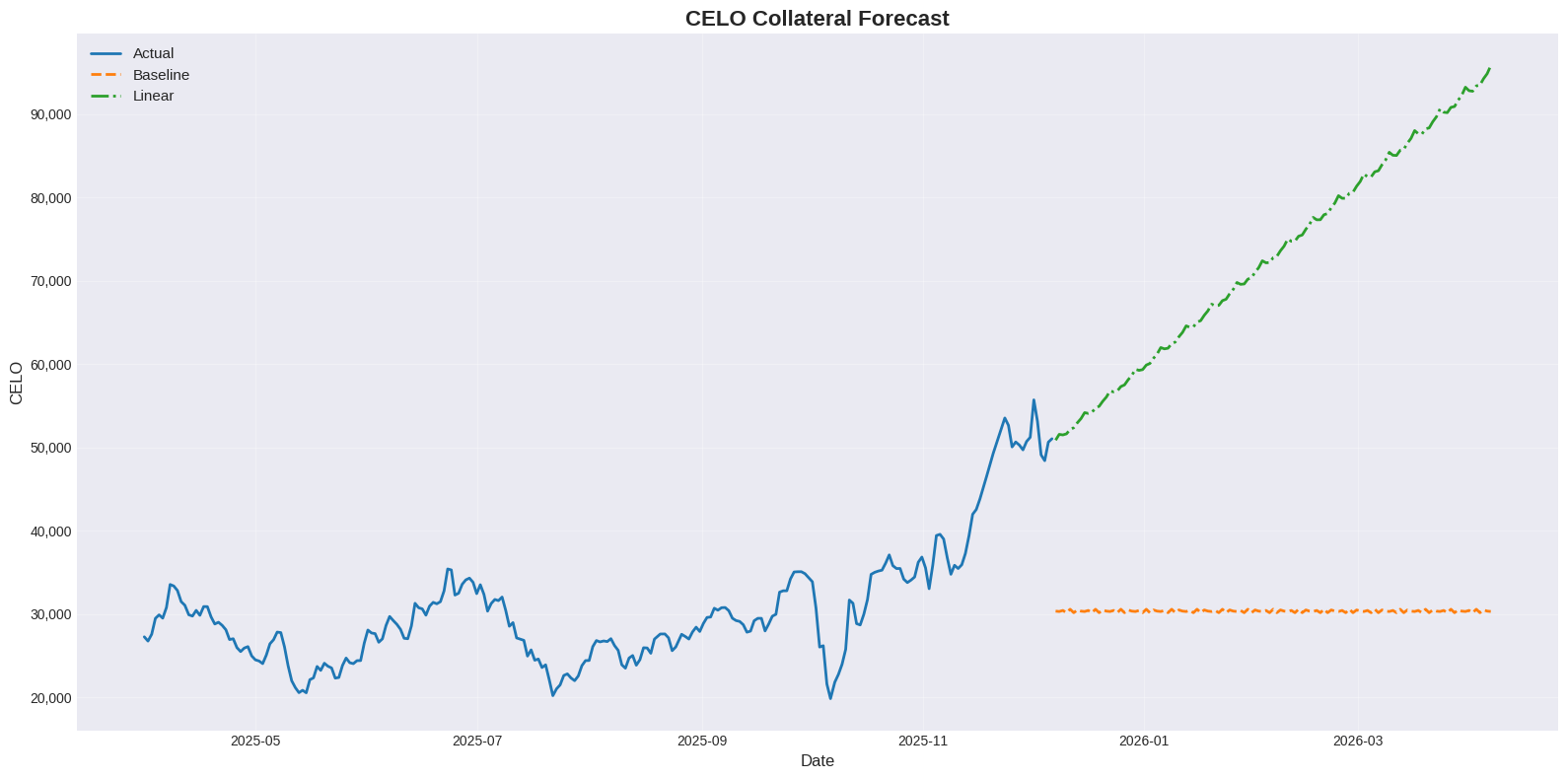
Using this empirical data, we can model a time-series forecast to determine CELO release at different price points.

  1. Baseline (flat, stable price): With 30k CELO daily collateral (approximate average Celo price of $0.30 through April 2026) this would result in a total annual emission of 11.07M CELO.
  2. Bear case (linear decline): A linear decline of the CELO price to around $0.09 through April 2026 would result in a total emission of 16.2M CELO.

Under stressed price (bear) conditions, the status quo would achieve an annualized inflation of 2.7% of the circulating supply. While in reality it is expected that the emissions would be significantly closer, if not less, than what is already suggested as an acceptable figure (~2.2%).

While efficiency is always a goal, the data indicates the “crisis-level” figures suggested do not reflect the on-chain reality.

8 Likes

If cUSD is converted into CELO via Mento Protocol and the CELO is sold on a CEX (because cUSD doesn’t have as much CEX liquidity), this would put incremental sell pressure on CELO vis-a-vis CEX, which is where price discovery happens.

This short-term buying/selling is not actually the main point though. The main point is we can reduce long-term spending on validators by 50% with negligible impact to the network. As we’re not an L1, where validators provided critical security infrastructure, keeping the validator set unchanged does not make sense.

I’m not sure if the “personal interests” comment is directed at me? My financial interests include being a CELO holder if that’s what you mean? So yes, I do hope CELO can go up vis-a-vis spending cut initiatives and raising revenue (via transaction fee burns, etc.).

1 Like

I personally 100% agree it’d be a good idea to reduce the number of validators in a group, for example, to 3 from 5. I didn’t include it in the original proposal as it wasn’t the main objective and I was worried it’d be a distraction. If people are fully aligned on this point though (e.g. not controversial)??, I would love to include it in the proposal.

1 Like

I think it’s a good point, it took me forever to de-register Tango, frustratingly long. I wonder if 1 day is too short though for validator deregistration? Is there maybe a good midpoint like 7 days?

As mentioned on validator group reduction, this wasn’t my or Luuk’s original core focus of the post. BUT, if this is something not controversial though (??), I’m personally open to adding it to the original proposal, especially having personally gone through this painful slow process.

2 Likes

I think the only requirement (Marek commented on it) was that it shouldn’t be shorter than the regular unlock CELO duration. 7-days for validator, 10-days for group or something would work well.

I would be in favor of reducing the cooldown unlock to 7 days for validators and 10 days for groups.

I’m also in favor of reducing max nodes per group from 5 to 3.

Let’s merge those changes in the proposal @alex_Verda?

1 Like

Speaking as a governance delegate here - pretending I’m the CFO of “Celo Incorporated”:

@alex_Verda If the goal is to save money, what’s the rationale for not reducing validator count to zero? This would 1) maximise the goal and 2) affect everyone equally.

If there are other considerations what are they?

Could we not be having the same conversation in 6 months to pull the band-aid off completely? Given the tighter pace of action and decision making in the market right now, it feels like we’re baking in tech debt to have to revisit this entire conversation again.

Here’s a framing that I think makes sense for this proposal:

  1. Marek clearly wrote in detail that decentralized sequencing is clearly in the exploration / would be nice to have / maybe there’s another future for validators zone.
  2. Renee has recently started a tokenomics working group so nothing is off the table right now.
  3. Validators aren’t needed now and times are tough - we can’t be leaking money for “nice to have folks running the stack and testing out cLabs’ tooling”.
  4. Non-validating RPCs are a commodity in 2025 and if Celo needs infrastructure urgently we’ll pay an enterprise who specializes in this to do it in a normal B2B deal through CICLOPS

Therefore, this proposal aims to reduce rewards to zero (first priority) and optionally (better experience for validators) reduce unlock times.

Speaking more personally:

Mixing in all these other changes like reduce elected groups and number of validators is difficult to justify any one number over another. Why not 60? Why not 35, 42 etc etc? Especially relevant given some of the questions around the accuracy of calculations in this thread.

Taking it to it’s extreme, we don’t even need technical governance for this, you could run a temperature check requesting the Score Management Committee to reduce everyone’s scores to zero and set the owner of the ScoreManager contract to the burn address (or cLabs, or the security council). Likewise, the Score Management Committee could enact the same financial impact of reducing to 55 validators by simply scaling everyone’s scores equally down by 50% under the current uptime / performance-monitored system.

Couldn’t we also just re-configure the 80-90cUSD per validator-epoch reward to be 50% of the current value? I don’t see any reason why we can’t impact everyone equally especially since the number 55 is just “half of current number”. The only argument I heard against this idea was from @LuukDAO who said “that would reduce the ROI per individual validator as their operational spend ratio woud go up” - which is true, but I think that’s fine. It’s actually a good side effect: the most efficient providers will keep going (likely to be operationally mature), and those who want a higher ROI will make that decision independently and we might have a staggered / organic unlocking of groups over time who want a different capital efficiency elsewhere.

If there’s another consideration at play to keeping the top groups by stake weight around we should hear this out also (it could be a good reason).

Obviously myself and others would be affected by this however it falls, but clearly shouldn’t be anyone’s consideration here.

6 Likes

This actually is the only meaningful number of “validators“ now. There is no need to be a “charity“ here. When the opportunity (AKA decentralized sequencer) comes there will be enough professionals who will gladly fight (as in “competition“) to get a place in a set by providing better services.

2 Likes

@Thylacine @AGx10000 I agree with your logic, but it does seem like a pretty dramatic move to go to 0. Exploring an alternative, what do you think about reducing the validator rewards by 50% instead of touching the number of validators? This would also largely solve for “affect everyone equally.”

:oncoming_bus: Validator Changes: Respect Investment, Justify Cuts, Weigh Stake … some thoughts…

1. Respect the investment. Validators - and the delegators who stake on them—have put in real work and capital that matters beyond this waiting period for a decentralized sequencer. Please acknowledge this openly and kindly.

2. Justify any cuts with numbers. If we’re cutting validators, show the exact budget shortfall , the expected monthly savings , and where those funds will go (compared to the entire Celo budget). Without this, I’m not convinced cuts are the best option. (See analysis above) and wait on a detailed report/plan like (What Rene is suggesting)

3. If cuts are truly needed, weigh stake fairly. Validator groups hold very different amounts of stake/votes and many (Like Grassroots Economics) reinvest into the ecosystem. Any reduction should reflect that reality (clear criteria, not one-size-fits-all).

6 Likes

This gets to the heart of why I keep poking at this proposal.

We should be using logic for a problem space that is purely economic. The claim is we need to save money on an unnecessary expense. If the suggested solution only partially addresses this I think it should be clear why.

If there’s a human or goodwill consideration bundled in there to not affect the existing actors so dramatically at once, this should be part of the conversation. If there’s another consideration that we might want to keep groups like Grassroots Economics or CeloPG or other actors who broadly contribute those returns back to the community (they would surely be in the 55), then I would argue we shouldn’t misuse an infrastructure allowance for public goods. Entities that have enduring value to the ecosystem should be granted annually or seasonally directly, not via an outdated mechanism that was designed to pay professional infrastructure providers for securing PoS.

A future-forward setup would be more like:

  • PoS reward system retired fully so not to repeat this entire conversation and human governance-hours in X months
  • Valuable public goods named and identified, granted directly via governance on a Seasonal / annual cadence.
  • Commercial RPC services provided at a top-level by Forno (and already covered by enterprises like Quicknode, Alchemy, etc). Forno directly funded by governance or CICLOPS for extension and maintenance if need be. Forno program owner and contact points named, documented, and searchable.
  • Community RPC services added to Lavanet / Pokt or something similar and incentivized by a small CELO bonus pool (again managed and refilled by Celo governance). Community program owner and contact points named, documented, searchable, and remunerated by the same goverance program refilling the bonus pool.

I’m not trying to scuttle this proposal by miring it in “what if’s”, but the 55 number seems kind of hand wavy and perhaps even the figures behind it questionable (the > 100 cUSD per validator-epoch also incorrect).

If the motivating urge is “just do something”, I can understand that. But the discussion has been floating around for many weeks now and I think for everyone’s time investment sake, we’re better off laying everything out such that the setup is robust for 2026 and beyond.

6 Likes

First off, big respect for this comment @Thylacine. You are literally a validator and on the Score Management Committee, yet you are arguing to shrink a revenue stream that benefits you directly. That is exactly the kind of alignment you want around a community fund with limited runway.

I also agree with your core framing. This is an economic problem; trying to stop spending money on a mechanism that no longer matches its original purpose. If the solution only half solves that, it is fair to question it.

Trying to subsidize public goods through an old infra allowance is messy and fragile.

I think we should turn your “future forward” outline into a concrete follow up.

3 Likes

I fear the community doesn’t really have the mandate to execute at this level. But if there’s more interest in something like this I could consider championing it.

2 Likes

After reading the full discussion, I think the motivation behind this proposal is still unclear. The economic argument used to justify cutting the validator set doesn’t hold up when looking at actual data. As @kamikazechaser conclude with onchain data:

which is exactly the target the proposal claims to aim for.

If the emissions situation is already near the desired range, then the claim that we “must” reduce validators to solve a tokenomics problem is simply not supported.

I also agree with @Thylacine’s framing:

If the real goal is to stop spending money on an outdated Proof of Stake mechanism, then it should be addressed directly.

To me, this proposal reads like a validator payment cut justified with reasoning that doesn’t reflect the actual situation. If the argument is really that Celo doesn’t need 110 validators anymore (Which might be real at this moment) then just say that clearly.

And if the proposal wants to move forward, it should do so with fairness, for example by reducing rewards by ~55%, reducing the number of validators per group, or applying proportional adjustments instead of eliminating half of the active set outright. As @ThirdEyeDelegate pointed out,

Similarly, @Thylacine noted that the number 55 itself “seems kind of hand wavy,”

And that if the goal is economic efficiency, then the solution should match that goal rather than a random target. @AGx10000 also pushed back on assumptions presented as fact, warning that claims without solid analysis.

These concerns all point to the same thing:
Clear motivation, accurate data, and rational methodology are needed before making a structural change of this size. A well grounded and transparent process would make the discussion much easier for everyone to evaluate.

I agree with what @Thylacine and others have said here.
The validator cut is similar to the gas fee increase decision, there’s no logic behind it.

To me it is obvious that the “money printing” has to main purposes, first one is to reward investors ie celo holders and the other is to support projects and ecosystem growth.
We can switch the conversation to talk how we allocate funds maybe as part of the tokenomics change.

5 Likes